Placentia West Co-op Transportation Society
Roger Carter
The third attempt to establish a central organization for Placentia Bay co-ops appears to have started in 1951, at a conference held in Little Paradise. There, fishers and co-op leaders discussed the pooling and group marketing of fish. (1) This idea was pursued by government co-op field staff. A fieldworker reported in October of 1951:
"We have attached great importance to the ownership and operation of a freighting vessel in the area...It is not too difficult to visualize a co-operatively owned schooner plying between here and the mainland bringing in supplies and taking fish to market."(2)
In 1954, a fieldworker reported that he was assisting Placentia Bay co-ops in arranging the charter of a vessel which would bring vegetables direct to the co-ops from Island Co-op Services in Prince Edward Island. (3)
Placentia West Co-op Transportation Society was registered on October 14, 1955, based in Merasheen (which became the central point of marketing for the whole area). (4) The society made several attempts to charter a vessel but they were unsuccessful. A decision was then made to try and purchase a boat.
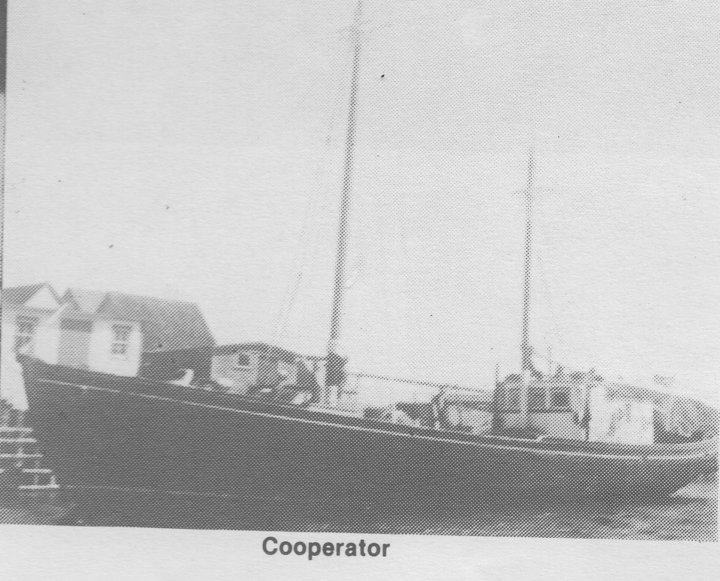 Early in 1956, the Transportation Society applied for a loan from the Co-op Development Loan Board to purchase a vessel, and a $16,000 loan was approved in May of 1956. The member co-ops invested between $4,000 and $10,000 of their own money, obtained a $2,500 loan for working capital from the Newfoundland Co-op Credit Society, and bought the M.V. Kean Brothers and re-named it the Co-operator II. (The original Co-operator was a schooner operated by the Grenfell Association). (5) The Director of Co-op Extension wrote the society, emphasizing the importance of this development to other co-ops in the Province. He wrote:
"The operation of a transportation service is undoubtedly more difficult than anything that has been tackled co-operatively in Newfoundland heretofore...[This development]...could have far reaching effects throughout the rest of the Province. There is an existing need and your efforts should have the effect of awakening more people and more societies to it." (6)
Membership in the Transportation Society was open to co-ops throughout Placentia Bay, and the number of members varied from year to year. In October of 1958, membership consisted of three registered consumer societies, including co-ops at Merasheen, Little Paradise and Oderin. The un-registered consumer co-ops at Red Island, Isle Valen, St. Ann's and Petite Forte were also members. Co-ops at Freshwater, Kingwell and Presque were also members at one time or another. (7)
Some co-ops in Placentia Bay took advantage of the Transportation Co-op's services without becoming members. For example, an un-registered Agricultural Society at Marystown placed orders, and the Fox Harbour Consumers Society bought coal through the Transportation Co-op without joining. (8)
In 1956, the Transportation Society shipped 2,755 drafts of heavy salted fish and 3,765 quintals of dry fish direct to markets in Nova Scotia. The fish came from Isle Valen, St. Ann's, Petite Forte and Oderin. (9) The success of this marketing venture created interest in the Transportation Society in some other areas, especially in areas where fishers were already co-operating. For example, in Baine Harbour, fishers were already pooling their own fish, and apparently avoiding the small local merchant by selling direct to larger regional buyers.
In 1957, it was reported that the pooling at Baine Harbour earned fishers an average of$10.50 per draft of dried cod while in such areas as Bay L'Argent where no pooling was done, the average price was only $8.50 a draft. The Baine Harbour fishers took a keen interest in the Transportation Society because it created the possibility of avoiding even the regional merchant and increasing the returns to the primary producers. (10)
The idea of avoiding not only small local merchants but also the larger St. John's based firms was a revolutionary one. Except for the lobster marketing operations on the North West Coast and the Fishermen's Union Trading Company, this had seldom been accomplished by primary producers. It was to be expected that just as the private merchants and other members of the establishment had opposed the Fishermen's Protective Union and the North West Coast lobster pools, they were also bitterly opposed to the Placentia West Co-op Transportation Society. If the society could achieve its objectives, the hold of the private merchants on the fishers of Placentia Bay could be broken, and if this co-op could succeed in Placentia Bay, then the idea could spread. So the Transportation Society had more problems to contend with than the logistical ones, although the logistical problems of making a venture like this work were themselves formidable enough.
Conferences were held periodically so that representatives of the local co-ops could plan their strategies, co-ordinate their activities and deal with such matters as the private merchants' opposition. In April of 1957 a conference was held in Baine Harbour aboard the society's schooner. Following the conference, a fieldworker met with the various co-ops and other fishermen's organizations on the west side of Placentia Bay. In July, another conference was held at Baine Harbour with representatives of the co-ops, fishermen's groups, directors of theTransportation Society and government staff in attendance. The executive of the Transportation Society was authorized to contact buyers in Nova Scotia requesting their fish prices.
Later, one Nova Scotian fish buyer made an attractive offer and advised that one of his company's representatives would be in Merasheen within a week. The company advised the society:
"...to hold over any action on the matter pending his arrival. The fishermen waited at first expectantly and then impatiently but no representative arrived at Merasheen. It was later learned from a reliable source that he reached no further than the office of one of the biggest competitors in the area, at St. John's. The delay and consequent frustration resulted in the first break among the ranks of the fishermen, the locals fell out and made other arrangements for disposing of their catch." (11)
The collusion of the Nova Scotia and Newfoundland merchants might be somewhat surprising, given that the Nova Scotia merchants could have profited from the venture with the Transportation Society. However, some of the other opposition tactics were common in Newfoundland communities where the interests of private merchants and primary producers collided. In September of 1957, the fieldworker in the area reported:
"...At mid-August all fish from Merasheen to Oderin was still held by the fishermen's co-operatives who were awaiting the arrival of their vessel to begin the first shipments. Meantime considerable pressure was being applied by competitors and to worker's personal knowledge prices were offered to individual fishermen, in particular those promoting the venture, which ranged a great deal higher than at any time heretofore quoted in this area, this too in spite of the fact that the trap fish in the Placentia Bay area this year was without doubt the smallest run on record." (12)
The merchants' opposition tactics combined with some bad luck on the part of the Transportation Society. The Co-operator was put out of commission by a twisted propeller shaft and this caused delays in getting fish from the 1957 season to market. According to a fieldworker:
"...The consequent frustrating delay became nearly the straw that broke the camel's back and whatever hope was still held for a complete success of the venture was knocked into a cocked hat when a number of fishermen-members disposed of their catch to local buyers.
All is not lost, however, for...the Co-operator II is plying her way to Nova Scotia with a cargo of fish, shipped by the hard-core and back-bone of the organization who refused to give up though these are the same fishermen mentioned above who were offered from time to time more attractive prices than any of the others." (13)
In 1957, the Transportation Society succeeded in shipping 234,425 pounds of fish to Lunenburg, Nova Scotia for which it earned $14,845. (14) The venture also succeeded in causing fish prices to rise between 50¢ and $1.00 per quintal, even for those fishers who caved in and sold to local buyers. (15) The Co-operator also brought consumer items direct from Halifax to the Placentia Bay societies, resulting in increased savings to the Placentia Bay co-operators.
The fact that some fishers had, under pressure, sold to local buyers, caused resentment among many of those who insisted on marketing through the co-op. A fieldworker cautioned:
"It is evident that there are still many weaknesses in the organization but one should not be too hasty in condemning the action of those fishermen who did not hold out to the bitter end and who apparently let down their fellow members. Other factors must be considered such as their financial position and that of their shoremen, the delay and frustration involved in the whole transaction. Furthermore, it must be remembered that in many subtle ways those who by no means have the best interests of the fishermen at heart and have for as long had them under their thumb, used their influence and position to coerce, discourage and hamstring the whole operation." (16)
The precarious financial position of the Transportation Society was perhaps first revealed in July of 1958 when the Co-operator II was docked in Sydney to pick up a load of coal. The banks would not finance the shipment and the vessel had to remain tied up. According to the government's Director of Co-ops, the only solution lay with the local Placentia Bay Co-ops themselves. He sent a telegram to the societies, stating: "It is a must for the Executive to meet and face up to responsibilities otherwise what has taken years to build is likely to crumble overnight." (17) It is not certain whether the Transportation Society was able to purchase the load of coal, but in August the Co-op Development Loan Board wrote the society, advising it that $2,503 on its loan was outstanding. (18)
A government audit of the Transportation Society in the summer of 1958 showed a deficit of $12,628. A combination of factors was considered responsible for the society's poor condition, including poor management, circumstances over which no one had control, failure of member societies to assume their fair share of responsibility, and the fact that the Board of Directors was too lax. Perhaps most importantly, the society was being used for something other than what was intended. It was supposed to have been a transportation service for consumers and producers in the area but it turned into a central purchasing and selling agency. According to the Director of Co-op Extension, if the Transportation Society operated properly it would only need enough capital to operate the vessel. Instead, it had accumulated relatively large trade accounts receivable and payable, which it should never have done. He recommended that the society's manager be replaced and this was done. (19) The society was re-organized with a new manager in the fall of 1958. (20)
Despite the Transportation Society's problems, it did manage to ship some fish direct to Nova Scotia in 1958, and again in 1959. A fieldworker reported in September of 1959 that for the third successive season the co-op's salt fish marketing venture was carried out with "considerable success." (21)
In October of 1959, it was reported that the Co-operator was tied up and was unable to supply all its orders for coal from the various local co-ops. (22) The result was "...top high prices locally in coal supplies to those who were compelled as a consequence to buy through local private suppliers." (23)
It appears that some of the local private merchants were increasing their pressure on the Transportation Society. There were rumours that the crew of the Co-operator would not get paid and that someone was trying to buy the vessel. (24) The Transportation Society's manager wrote the Registry:
"I know there are plenty of private firms would like to have...[the Co-operator] for several reasons, the worst one is when we have her she is too much competition. If she was gone from us the coast would be clear for them to pay what they like for fish and ask what ever came to their mouth for coal, vegetables etc." (25)
Aside from the problems associated with the private merchants, however, were the problems related to the society's members and their expectations of the society. Despite a change of management and a warning by the Registry in 1958 that too much was being expected of the Transportation Society, not much changed in that regard. In October of 1959, the Director of Co-op Extension again addressed the issue. He wrote that the members expected too much of the society. They expected the society to provide transportation and the services of a wholesale buying club and marketing association. The co-op arranged for bulk purchases of coal for example, and was expected to deliver small quantities to many ports, with no mark-up. Similarly, the society was not only transporting fish but was also acting as an agent of the fishers. While it was being paid for transporting the fish, the society got nothing for doing the bargaining, culling the fish, or for doing other things as the fishers' agent. According to a former Registar, the people expected pick-up and delivery at every stage head, instead of using central locations, and the delays cost $60.00 per day with no income from lost time. (26) The Registrar wrote:
"...there is an attitude among individual members of the member societies...not unlike that of the Fur Farmers. They will not pay for the services they require in addition to carriage such as brokerage and agency services on fish sales and purchases of merchandise." (27)
In 1960, there were complaints from the Transportation Society's manager that the members were not being very co-operative. The co-op at Paradise had refused to take all the vegetables it had ordered; the one at Isle Valen would not wait for the Co-operator's arrival, and bought from a private merchant. Consequently the Transportation Society was stuck with $500 or $600 worth of vegetables it couldn't sell. Also, 78 sacks of flour had water spots on them and the local co-ops would not accept them. (28)
In the spring of 1961, the Transportation Society was owed about $1,700 in new accounts receivable by its member co-ops, and some creditors, including the Fisheries Loan Board were inquiring into the society's operations. (29) The Director of Co-op Extension warned the society that the Loan Board was quite concerned. He wrote:
"I don't believe they will tolerate any further vagueness. Their terms of grace have just about run out and unless the Society can come up with some concrete proposals soon, the Board is likely to step in." (30)
Another problem for the Transportation Society was that the Co-operator II was expensive to operate and maintain. The member co-ops did not have extra capital to invest in the vessel and there were several reports of problems related to lack of maintenance. In December of 1959 for example, the Transportation Co-op's manager wrote that the boat's crew was leaving because of leaks and lack of maintenance. (31)
In order to make the Co-operator II viable, the Transportation Co-op had to try and keep the vessel occupied, with as little down-time as possible. It was in contact with groups from as far away as Bay de Verde and the North West Coast in an attempt to obtain contracts or charters for the boat. In 1958 for example, UMF was contacted to see if it would be interested in hiring the Co-operator II in its lobster marketing operations on the North West Coast. UMF replied that with the developing road network and the increasing use of trucks they had no use for the boat. (32)
By early 1962, the Transportation Society was in deep trouble. The Fisheries Loan Board and other creditors were pressing for payment of their bills and the society had very few funds available. In March it was reported that the Co-operator II needed engine and deck repairs costing $5,000 but the Transportation Society could not raise sufficient funds to finance it. The co-op had $638 cash on hand and Accounts Receivable of $1,415 but it had Accounts Payable of $6,642 and it still owed $12,730 to the Loan Board. (33)
In April of 1962, members of the Transportation Society met in Little Paradise to determine whether the co-op should continue operations. Except for the Merasheen Consumers Co-op which said it could not afford to invest more money in the operation, the members agreed to invest more capital in the venture. (34) (The Merasheen Consumers Society was by far the largest shareholder in the Transportation Society with $3,438 invested. Little Paradise, and Oderin Consumers each had $1,709 in shares, Red Island Consumers had $829, Presque Consumers had $740, Petite Forte Consumers had $709 and Isle au Valen Consumers had $609 invested in share capital). (35) At the Little Paradise meeting, the members of the Transportation Society decided to retain the Co-operator II and to use the vessel for fishing as well as for transporting goods to and from the markets. The members felt that although the Transportation Society had not provided direct financial returns to its members, it had been responsible for keeping prices of produce and coal at a minimum level, for increasing fish prices and for providing a valuable service to consumer societies. (36)
With a small infusion of capital from its members, the Transportation Society repaired the Co-operator II's engines, outfitted the vessel for fishing and sent it to fish in Golden Bay. (37) According to a former Registrar, the Golden Bay fishing experiment failed because the Department of Transport refused to license the Captain because he was colour blind. By the autumn of 1962, the Co-operator II's engine was inoperative and the Transportation Society was deeper in debt. (38) An attempt to get higher fish prices by marketing through the society failed due to "...rigid control by the various fish buyers." (39)
With its relatively large debt, the Transportation Society was virtually insolvent by October of 1962. Indeed, the Fisheries Loan Board (which held the first mortgage on the Co-operator II) had considered re-possessing the vessel several times but each time it decided to give the society another chance because "...such action would put [the Transportation Society] into insolvency, and cripple the member Societies..." (40) For several years at least, it was probably good will on the part of the Provincial Government as much as anything else which kept the Transportation Society in operation. According to a fieldworker, the government had to be supportive because:
"...loss of this society in addition to its immediate effect would do tremendous damage psychologically on the co-operatives in Placentia Bay. Certainly, there will be little enthusiasm for new development of any kind for a long time." (41)
Some of the co-operators in Placentia Bay felt, however, that government was not going far enough, and that it should forgive the society's loan on the Co-operator II. They felt that this would be similar to the government providing roads and other services in less isolated areas. (42)
Beginning in the autumn of 1962, the Co-operator II remained idle in the harbour at Oderin, while creditors pressed for payment. One company gave its lawyers instructions to arrest the vessel because of unpaid bills. (43) In the Spring of 1963, a fieldworker contacted the members of the Transportation Society with respect to the pending sale of the Co-operator II. The boat was to be sold because:
"...no further course of action was available. This is understood and has been agreed to by all member societies." (44)
In May of 1963, the vessel was advertised for sale by the Fisheries Loan Board, and it was sold in February of 1964. The sale realized 53.5 percent of the Transportation Society's total indebtedness. (45)
The Fisheries Loan Board originally lost $6,113 in principal and interest on the Co-operator II, but recovered all its losses from insurance when the intended buyer ran the boat aground. The Transportation Society's members lost almost $10,000 in share capital. Additionally, the member societies which owed money to the Transportation Co-op were sent bills for these amounts. For example, there was a claim against the Merasheen Consumers Co-op for $1,150. (46)
The Transportation Society had been a risky business venture, partly because of the general economic conditions and government policy toward rural communities in Placentia Bay. In 1967 the Registrar wrote:
"This was a brave but perhaps foolhardy venture and maybe the handwriting was on the wall for the Placentia Bay communities. Those involved have now been or are in the process of being transferred from the islands under the Fisheries Resettlement Program." (47)
After about four years of being inactive, the registration of the Placentia West Co-op Transportation Society was cancelled on October 24, 1967. (48) Upon liquidation, $570 (representing the total assets of the Transportation Society) were sent to the Co-op Development Loan Board as a partial payment on its loan to the society. (49)
Editor's note: Information researched, developed and remains the copyright of Roger Carter. Used with permission.
References
1. Report of field worker, August 12, 1951, CRF Box 1773.
2. Report of field worker, October 29, 1951, CRF Box 1773.
3. Letter from field worker, October 22, 1954, CRF Box 1773.
4. Constitution file, Placentia West Co-op Transportation Society, October 14, 1955, CRF Box 1773.
5. Letter from Director, Co-op Extension, June 1, 1956; memo from Registrar to Minister, Mines, Agriculture and Resources, October 20, 1967, CRF Box 9262; letter from Chairman, Fisheries Loan Board to Attorney General, October 16, 1962, CRF Box 9542. Wilfred Dawe, Personal Correspondence, ca. 1995.
6. Letter from Director, Co-op Extension, June 1, 1956, CRF Box 9262.
7. Letter from Director of Co-operation, January 3, 1956; Liquidator's Report, November 29, 1967, CRF Box 9262.
8. Report of field worker, October 1958, CRF Box 1782; report of field worker, August 4, 1954, CRF Box 9233.
9. Report of field worker, May 1957, CRF Box 1782.
10. Ibid.
11. Report of field worker, September 5, 1957, CRF Box 1782.
12. Ibid.
13. Ibid.
14. Report of field worker, October 10, 1957, CRF Box 1773.
15. Report of field worker, September 5, 1957, CRF Box 1782.
16. Ibid.
17. Director of Co-op Extension, Night Letter to Placentia Bay Societies, July 9, 1958, CRF Box 9262.
18. Letter from Co-op Development Loan Board to Placentia West Transportation Society, August 5, 1958, CRF Box 9262.
19. Memo from Director of Co-op Extension to Minister responsible for Co-ops, August 26, 1958, CRF Box 9262.
20. Letter from Registrar, September 19, 1958, CRF Box 9262 and Report of field worker, October 1958, CRF Box 1782.
21. Report of field worker, September 1959, CRF Box 1782.
22. Report of field worker, October 1959, CRF Box 1782.
23. Report of field worker, November 1959, CRF Box 1782.
24. Letter from Registrar, December 21, 1959, CRF Box 9262.
25. Letter from Manager, PWCTS to Registry, October 17, 1959, CRF Box 9262.
26. Letter from Director of Co-op Extension, October 29, 1959, CRF Box 9262; Wilfred Dawe, Personal correspondence, ca. 1995.
27. Letter from Registrar, October 30, 1959, CRF Box 9262. The Registrar is referring here to the Fur Farmers Producers Co-op which was based at Dildo, Trinity Bay.
28. Letter from Registrar, December 13, 1960, CRF Box 9262.
29. Letter from Registrar, May 4, 1961, CRF Box 9262.
30. Letter from Director, Co-op Extension, April 6, 1961, CRF Box 1773.
31. Letter from PWTCS Manager, December 28, 1959, CRF Box 9262.
32. Letter from Registrar to UMF, November 17, 1958; Letter from UMF to Registrar, November 23, 1958, CRF Box 9262.
33. Report of field worker, March 6, 1962, CRF Box 1773.
34. Report of field worker, May 2, 1962, CRF Box 1782.
35. PWCTS Balance sheet, March 31, 1962, CRF Box 9542.
36. Report of field worker, May 2, 1961, CRF Box 1782.
37. Report of field worker May 1962, CRF Box 1782.
38. Interim Audit PWCTS, September 30, 1962, CRF Box 9542; Wilfred Dawe, personal correspondence, ca. 1995.
39. Report of field worker, September 1962, CRF Box 1782.
40. Letter from Chairman, Fisheries Loan Board to Attorney General, October 16, 1962, CRF Box 9542.
41. Letter from field worker, March 9, 1962, CRF Box 9262.
42. Ibid.
43. Letter from St. John's Law Firm to Registry, October 25, 1962, CRF Box 9542.
44. Report of field worker, May 1963, CRF Box 1782.
45. Letter from Fisheries Loan Board to Registry, February 21, 1964, CRF.
46. Memo from Registrar to Minister of Mines, Agriculture and Resources, October 20, 1967; Letter from Inspector of Co-ops to Registry, April 29, 1964, CRF Box 9262; Wilfred Dawe, personal correspondence, ca. 1995.
47. Memo from Registrar to Minister, October 20, 1967, op. cit.
48. Cancellation of Registration, October 24, 1967, CRF Box 9542.
49. Letter from Liquidator to Registry, November 22, 1967, CRF Box 9542.
Comments